A Unified Audio Engine
Mozart's audio engine is one C++ codebase that runs as WebAssembly in the browser, natively in Scout and natively on iPhone.
By Mozart Team3 min read
Every sound you hear while you work in Mozart comes from the same audio engine, whether it is a synth note in Studio, a loop in Layers or a take you have just recorded. The engine is written once, in C++, and it runs in three places. This post explains how that works and why we built it that way.
The idea
Music software often has one engine per platform. The web version gets one, the desktop version another and the phone a third, and over time the three drift apart. A project sounds a little different depending on where you open it, and every fix has to be made three times.
We wanted the same code to play your project everywhere. So Mozart has one engine, and each platform is a host for it.
Three places
- In the browser, the engine is compiled to WebAssembly and runs on the browser's audio thread. This is what plays your project when you open Studio or Layers with nothing installed.
- In Scout, our desktop app for Mac and Windows, the engine is compiled natively. Scout talks to your audio device and your MIDI gear and hosts your VST3 and Audio Unit plugins, so Studio can hand its audio to Scout when you want to use them.
- On iPhone, the engine is compiled natively into the app, where it plays live sessions.
How it stays one engine
The engine has two layers.
The first is a small graph runtime. The app describes your project as a graph: clips are scheduled on tracks, tracks feed a mixer, and effects sit on channels. The runtime receives that description as a list of instructions and plays it.
The second layer is the set of nodes the graph is made from. They are Mozart's own. There are arrangement nodes that play audio clips, MIDI and automation. There is a mixer with plugin delay compensation and sidechain routing. There are instruments, such as PolySynth, the samplers and the Rompler with its 44 multisampled instruments, and effects, such as Filter, Delay, Reverb, Distortion and a 7-band EQ. Every host registers the same nodes from the same source files.
Three habits keep the hosts from drifting:
- One change, one commit. A change to the engine and the changes each host needs land together.
- A published fingerprint. The engine records a fingerprint of its node set and its instruction format. The browser checks it and only works with a copy of Scout that matches.
- Tests that need no speakers. The instructions produced for real project graphs are compared with saved copies, the nodes are tested for correct audio, and native output is compared with WebAssembly output.
The hosts do differ in one important way. In the browser, everything the engine does happens on a single audio thread. A native host has a separate control thread, so the runtime swaps in new state without making the audio thread wait. Scout also adds two node kinds of its own, one for hosted plugins and one for audio input.
What it means for your music
- The same code plays your project in a browser tab and through Scout.
- An export is rendered by the engine you were listening to while you worked, as MP3, WAV or 32-bit float.
- One engine is live per device. If you open a project in a second tab, that tab takes over playback.
- A fix to an instrument or an effect is made once, in one place.
Recent changes
- In August 2026, a new version of the engine reduced its memory use.
- In October 2026, recording began to work with the native engine selected.
- On 1 November 2026, Scout 0.3.2 shipped with an engine that does less work per block when it is idle.
- The engine now loads only on the pages that need it, so most pages of the web app open faster.
Put your next idea into music.
Bring a brief, a melody or a new direction to Mozart.
Create with MozartKeep reading
Product
Mozart 2.0 for iPhone: native navigation, a play queue and a notifications inbox
Mozart 2.0 for iPhone brings native iOS navigation, a Now Playing queue, a notifications inbox and a new app icon.

Stories
A day at TYX Studios: what our first songwriting camp taught us
On 6 June 2026, London producers, rappers and songwriters spent a day making music with Mozart Studio. Here is what happened and what we learned.
Product
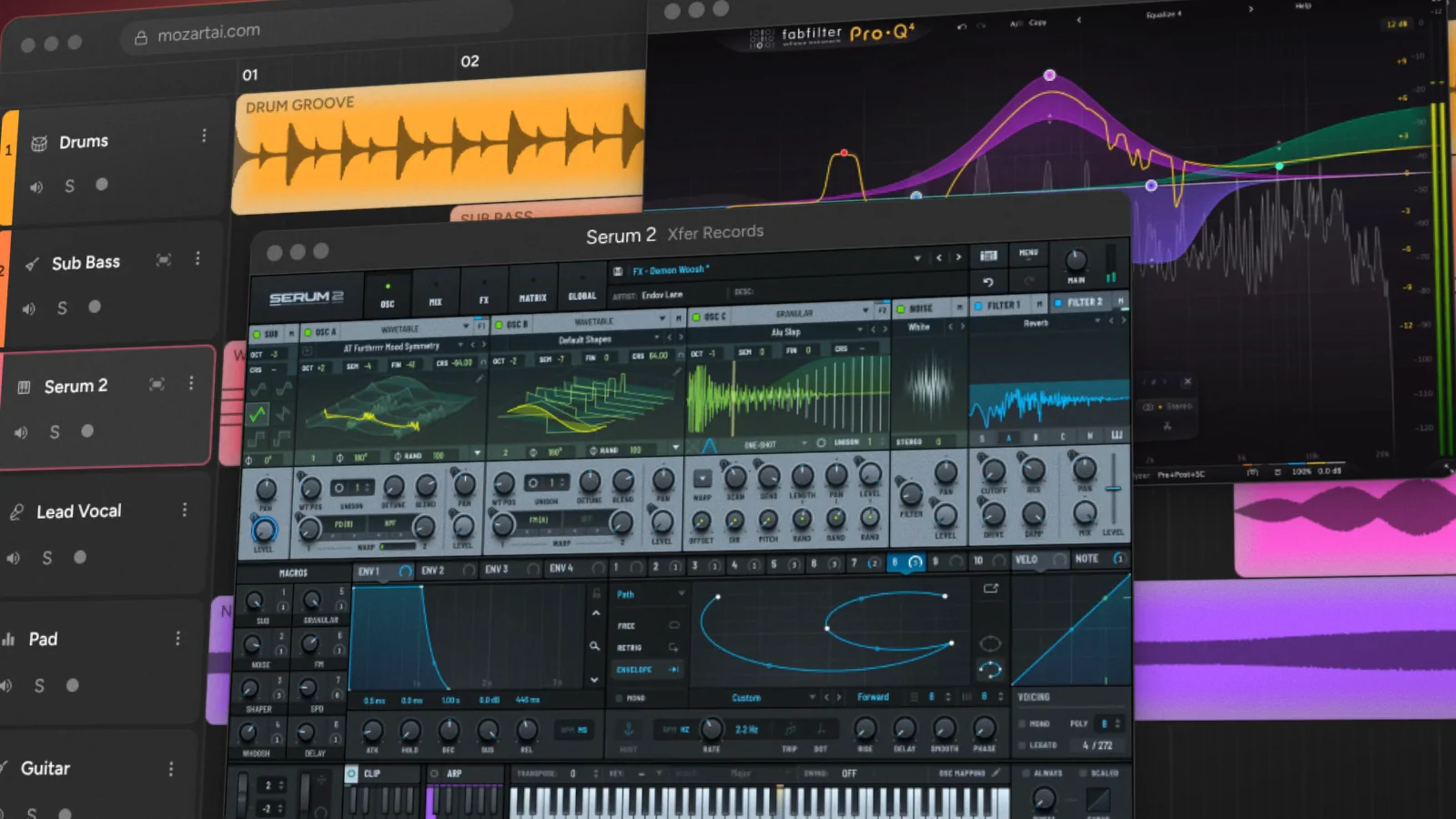
Studio 1.0 and Scout: your plugins in the browser, with AI that can use them
Studio 1.0 is a generative audio workstation in the browser. Scout connects the instrument and effect plugins on your computer to it.